
AudioEye has published new research that pairs a survey of web professionals with hands-on testing of AI coding tools, and the two halves of the study tell the same uncomfortable story: teams are shipping AI-generated code they believe is accessible, and it very often is not.
The accessibility platform asked five leading AI tools — from OpenAI, Anthropic, Google, xAI, and Lovable — to each build a news and media site, an online store, and a financial services site meeting WCAG 2.2 Level AA, the global accessibility standard. Every one of them failed, including at Level A, the most basic tier of the guidelines.
“Asked to build accessible code, every tool reproduced the inaccessible practices it learned from the web. Five independent tools broke the same components in the same ways. Switching tools gets you a different version of the same problem.”, the report notes.
Fifteen sites, 306 distinct issues, 59,000 occurrences
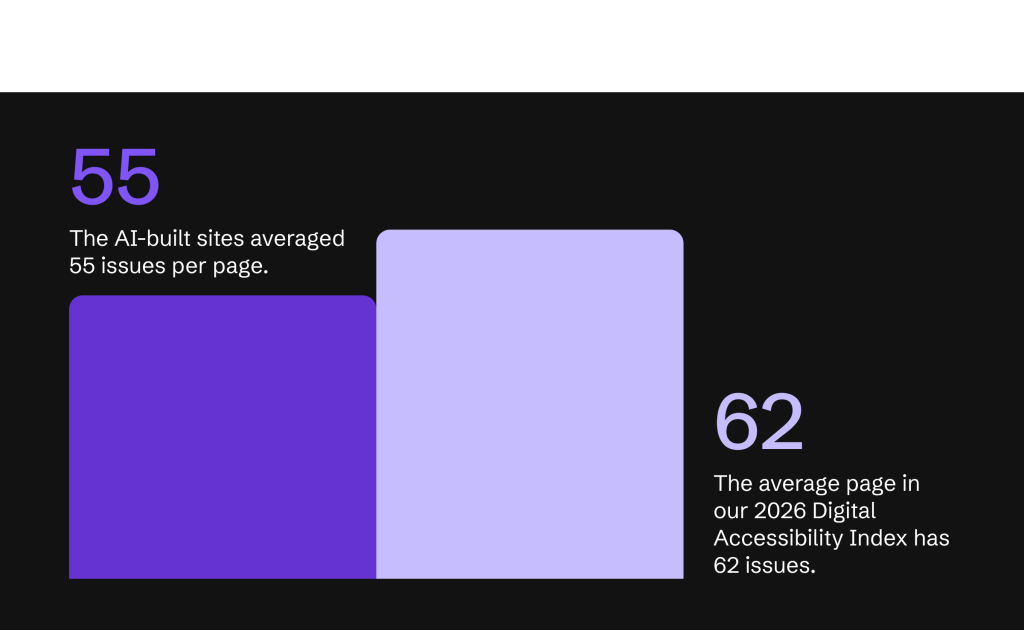
The 15 websites generated 306 distinct accessibility issues, which appeared more than 59,000 times across the sites. A single mistake in a navigation menu or form field repeats on every page that uses it — and the sites averaged 55 issues per page, against 62 for the average page in AudioEye’s 2026 Digital Accessibility Index. In other words, AI-built pages were essentially on par with the broader, notoriously inaccessible web.
The number of issues was not the only concern. AudioEye reported that 91% of the problems identified in its testing were classified as medium or high severity and 33% blocked a task outright — meaning someone using a screen reader literally could not check out, submit a form, or reach the content they came for. Thirteen of the 15 sites shipped at least one task-blocking issue.
AudioEye found that nearly half of the issues required interacting with the website to identify them. This includes testing whether focus moves correctly, whether a keyboard can close a dialog, or whether a screen reader properly announces a form error.
One example was skip links, which allow keyboard and screen reader users to bypass repeated navigation. Twelve of the 15 websites included skip links, but none correctly connected the link to a focusable target. The links could move the page visually, but keyboard focus remained at the top of the navigation.
eCommerce websites performed worst
The most problematic results emerged from AI-generated online stores. According to the study, AI-created eCommerce websites averaged 174 accessibility issues per page, more than three times higher than the overall average across the tested sites.
The study found, “When AI built the stores, they came out more than three times worse than the other sites it built. AI did not fail evenly. It failed hardest on the sites where people spend money.”
Shopping experiences often involve complex user interactions such as search, filtering, cart management, and checkout workflows, areas where accessibility failures can have a direct impact on user experience and business outcomes.
Worsening the situation, 78% of accessibility lawsuits target e-commerce, and that filings have doubled since 2020. “AI is building the most-sued pages on the web, and building them significantly worse than anything else it builds.”
The findings land at a moment when AI-authored code is flooding production environments. DX, which tracks engineering data across more than 400 companies, puts AI-written code at 51.9% of all code as of mid-2026 — up from 24% just two quarters earlier .
Developers’ confidence does not match reality
The survey portion exposes another deeper problem. AudioEye polled 231 web developers, content creators, and business leaders in August 2026; 75% already use AI to write code or create content, and 81% of those users are confident their AI-generated code meets accessibility standards. Yet 73% of that same confident group say accessibility issues or complaints have increased since adopting AI .
Nearly 40% do no specific accessibility review of AI-generated code at all, and only 29% of developers say they prompt AI tools to follow accessibility guidelines — even though 71% assume the output is accessible by default .
Prompting doesn’t rescue it, either. Sixty percent of developers who do specifically prompt for WCAG compliance still report more accessibility issues since adoption. And the overconfidence extends to self-review: 46% of AI users said they’d be “very confident” in an LLM’s own assessment of their site’s accessibility.
The legal exposure is already visible. 46% percent of organizations using AI to write code or create content received an accessibility complaint, demand letter, or lawsuit in the past 24 months — and 71% of those said AI was involved in building the page in question .
Widgets alone aren’t the answer
The survey also draws a line between tool strategies. Organizations relying solely on an accessibility widget were nearly twice as likely to have received a demand letter or lawsuit (71%) as those pairing automation with human accessibility expertise (36%) — despite both groups publishing similar volumes of AI-generated work . AudioEye attributes the gap to whether anyone tests pages with real assistive technology: nearly half the issues found in its hands-on testing were invisible in the code itself and only surfaced when someone actually used the pages.
This isn’t the only signal pointing at AI-assisted coding as an accessibility regression driver. WebAIM’s 2026 scan of the top one million home pages found 56.1 errors per page — the first decline in homepage accessibility in six years — and attributed the reversal in part to AI-assisted coding .
AI can write the code. Someone still needs to test it.
The report notes, “AI can build a website in an afternoon. It cannot tell you whether a person can use it, because it doesn’t have the capability to check.” With two-thirds of AI search traffic now landing on interior pages and 64% of 2025 accessibility claims citing issues on those pages, spot-checking a homepage no longer cuts it.
WCAG compliance is not simply a checklist that an AI model can reliably satisfy by adding the right HTML attributes or generating a few ARIA labels. Some accessibility problems only become obvious when someone actually navigates the interface with a keyboard or assistive technology.
The survey findings are a useful warning against treating AI-generated code as accessible by default.